Winter Formal 2026: What to Wear, When to Buy, and How Not to Freeze
Homecoming's barely in the rearview mirror and your group chat is already asking the next question: what are we wearing to winter formal?
Fair question. It's also the dance that never comes with a proper rulebook. Some schools run it like a mini prom, complete with a hotel ballroom and floor-length gowns. Others hold it in the gym with a photo booth and "semi-formal" printed on the flyer. Same name, wildly different nights.
So this guide doesn't pretend there's one right answer. It gives you a way to find yours: how to read your school's formality level, what's actually trending this season, when to order if you want the dress in your hands before the dance, and the part most guides skip entirely, how to dress for a December night without turning into a human icicle.
Let's get into it.
Winter formal is a school dance held in the colder months, usually December through February. It sits between homecoming and prom in formality, but your school sets the real rules.
- Check whether your dance is called semi-formal or formal.
- Read the dress code before you buy anything.
- Go for velvet, satin or heavy crepe in deep jewel tones.
- Order two to three months ahead if you can.
- Plan for the cold: wrap, closed-toe shoes, a dry walk from the car.
What winter formal actually is (and why it isn't homecoming part two)
A winter formal is a school dance held in the colder months, and according to My School Dance's explainer it usually lands somewhere between December and February. It's similar to prom, but it tends to be open to all students instead of just upperclassmen. Some schools add a sit-down meal, a court, or a girls-ask-guys twist.
Where it sits on the formality ladder is the tricky bit. Jovani's winter formal guide puts it between homecoming and prom: dressier than the first, not always as grand as the second, and the exact level depends on your school. That "depends on your school" is exactly where people get tripped up.
If you want the full breakdown of the other two dances first, our prom vs. homecoming guide covers it, and David's Bridal has a handy side-by-side too.
How to read your school's level in five minutes
Skip the guessing. Do this instead:
Read the flyer or ticket page. If it says semi-formal, you've got room to play. If it says formal, think gown.
Look at the venue. A hotel ballroom suggests a dressier night than a school gym, which is a tip straight from Jovani.
Find the dress code in your student handbook. This is the one that can get you turned away at the door.
Ask someone who went last year what people actually wore.
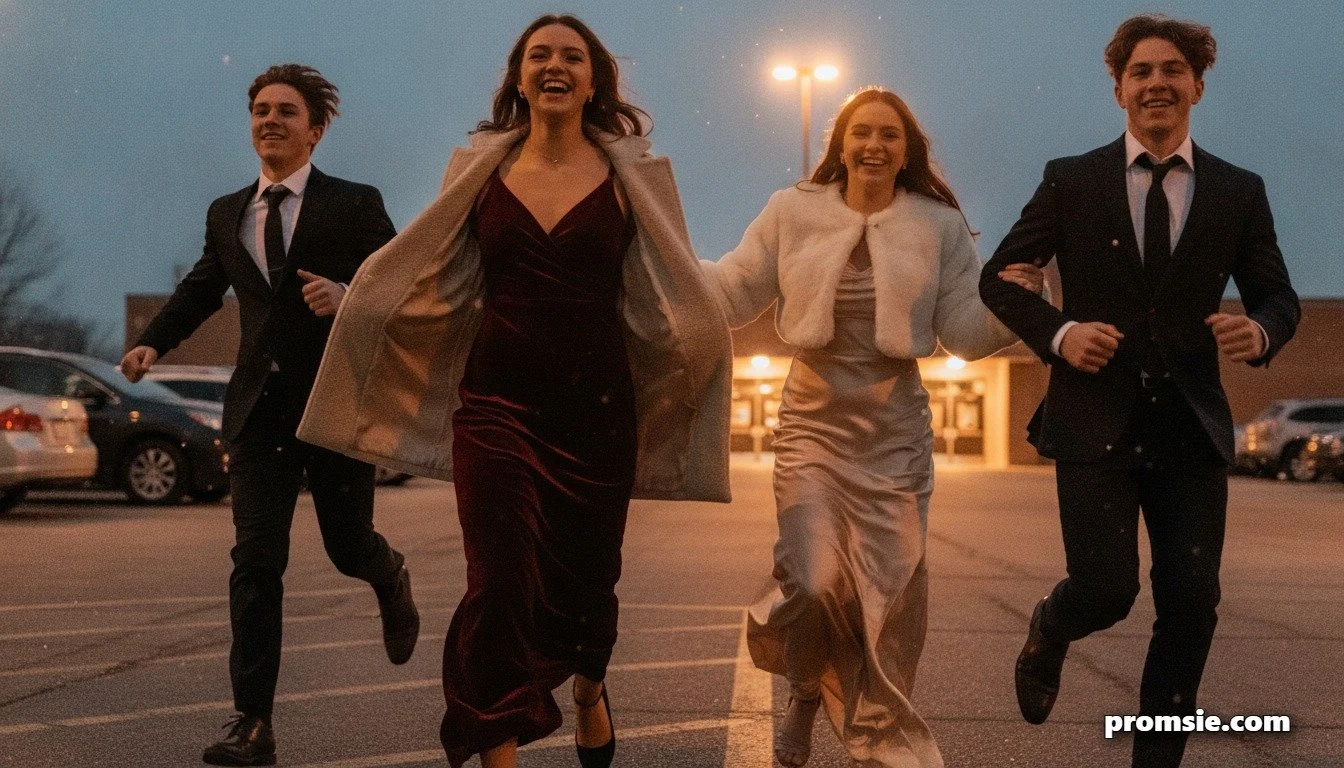
Real dress codes show how far apart schools can be. Sierra High School's published formal dance code says a formal dress must be fingertip length with arms fully extended, with slits held to the same limit, no bare midriffs or cutouts, and nothing see-through. A Louisiana Catholic school's 2025 winter formal rules go a step further: floor-length dresses, slits no higher than four inches above the knee, and dress shoes only.
Both are called winter formal. Those are very different shopping lists.
Run your dress through these five checks. School codes differ, but these are the rules that show up again and again.
- Length: some codes require floor length, others use a fingertip test with your arms down.
- Slit height: limits range from fingertip length to a few inches above the knee.
- Midriff and cutouts: many schools ban both.
- Back and neckline: check how low is too low.
- Shoes: some schools allow dress shoes only.
Still unsure? Email a front and back photo to your dean or activities office before you order.
Long, short, or somewhere in between?
Here's my honest take. If your school calls it formal, or the venue is dressy, go long. A floor-length gown reads elegant, suits the season, and (bonus) it's warmer. If it's a semi-formal gym night, a polished short or midi dress is completely fine, and Jovani says the same.
When you truly can't tell? Err longer. Overdressing a little at a semi-formal is a small problem. Getting sent home over a hemline is a big one.
A midi is the sneaky in-between that works at nearly every level of formality. Not sure which silhouette flatters you? Our guides on choosing a dress that actually fits your body, petite frames, and short vs. long plus-size dresses will narrow it down fast.
What's actually trending for winter formal 2026
Fall's runway mood is called "evening elegance," and Woman & Home's read on autumn/winter 2026 pairs it with rich berry-toned velvet. That's good news if you like drama, because winter formal is basically the perfect excuse for it.
Velvet is the move
Velvet is warm, it photographs with real depth, and it makes a dress look expensive without trying too hard. Azazie's winter dress guide ranks velvet, satin, stretch satin, and heavy crepe as the best fabrics for the season. Velvet does want dry cleaning and careful hanging, so don't stuff it in a gym bag.
Jewel tones and berry shades
Emerald, sapphire, ruby, and amethyst are Jovani's picks for a seasonal formal. Azazie adds burgundy, navy, plum, and classic black. Windsor's winter formal dress collection leans into fuchsia, magenta, and emerald alongside black, white, and deep red. Different retailers, same message: go deep and saturated.
Not sure which shade suits your skin tone? Our homecoming dress colors guide breaks it down shade by shade, and everything in it translates to winter.
Icy silver, pale blue, and white
Got a snowball or winter wonderland theme? Jovani suggests silver, pale blue, white, and shimmery metallics, which photograph beautifully under cool lighting. If you'd rather go moodier, stick with jewel tones and velvet.
Espresso brown and the quiet-luxury crowd
Chocolate and espresso shades have been climbing all season, and they're an easy way to look polished without screaming "look at me." Our brown dress guide and Prom 2027 trend report both cover how to wear it. And if you're a black-dress person (no judgment, it never fails), the black dress guide has fabric and styling ideas.
What to skip
Azazie flags chiffon and thin tulle as too lightweight and too summery for winter formals. I'd add one more thing: pastels in sheer fabrics tend to look thin under winter lighting. Deeper colors in heavier fabrics just feel right for the season.
Want to see where to actually buy? Our roundup of the best prom dress sites, sorted by what you need, works just as well for winter formal.
Staying warm without wrecking the look
This is the section nobody writes properly, and it's the one that decides whether you have a good night or a miserable one.
Start with coverage. Long sleeves, a higher neckline, or a longer hem all help, and Jovani and Azazie both recommend them. Going strapless or sleeveless? Plan a wrap, shawl, or faux-fur stole for arriving and leaving, then take it off inside.
Shoes matter more in winter than you'd think. Azazie recommends closed-toe heels or ankle boots, and warns against stilettos on ice or snow. Dress has a high slit? Our guide to styling slit dresses with knee-high boots shows how to keep the look sharp and the legs warm. Need comfort ideas for a night of dancing? Start with the prom shoe guide.
Then plan the walk from the car to the door. Sounds silly, but a wet, dark parking lot and a long hem are not friends. Jovani makes the same point about protecting your dress and shoes.
One more thing. Try the dress on with the layers you'll actually wear. Azazie lists skipping this as a classic cold-weather mistake, because a dress that fits alone can feel tight over tights or thermal layers. Not sure of your size? Run through our measuring guide before you order.
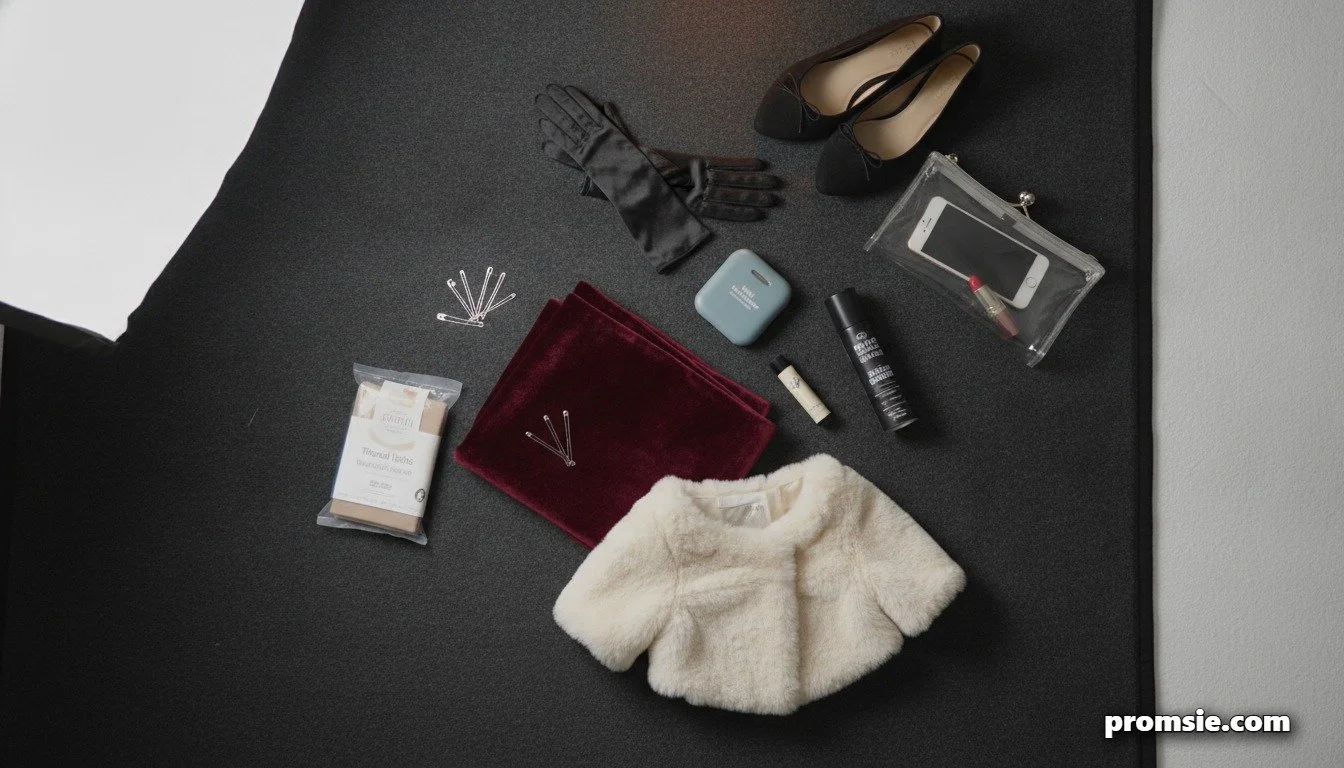
- A wrap, shawl, faux-fur stole or elegant coat that suits your dress color
- Closed-toe heels or ankle boots with some grip
- Tights or thermal layers (try the dress on with them first)
- A velvet bolero if your dress is strapless
- Blotting papers and a lip color for touch-ups
- A plan for a dry, short walk from the car to the door
Bags are worth a quick check too. Some schools have gone strict on bags, and our bag-ban guide covers how to carry the essentials without a clutch.
The countdown: when to buy
Today is mid-October. If your winter formal is the first weekend of December, you're roughly eight weeks out. That's tighter than it sounds once shipping and alterations enter the picture.
Azazie recommends ordering two to three months before the event, and it warns that peak-season delivery can stretch to four to six weeks. Our own rule from the prom vs. homecoming guide is eight to twelve weeks as a safe buffer. Jovani's advice is gentler, a few weeks before or earlier if you want a specific style. The common thread: sooner beats later, especially in November and December when everyone's ordering for the holidays.
So if your dance is in December, order now. January or February dance? You've got until about mid-November before it starts to feel tight.
Two more things before you click buy. First, check the return policy. Several special-occasion listings on Windsor's winter formal page note that those items can't be returned to its retail stores, and many formalwear brands have their own rules. Our shipping and returns guide walks through what to look for. Second, don't forget the stuff under the dress. The under-the-gown guide covers shapewear, tape, and foundations.
- 10 to 12 weeks out: pick your dress, check the return policy, and order.
- 6 to 8 weeks out: the dress arrives. Try it on with your layers and book alterations.
- 4 weeks out: first fitting. Order shoes, wrap and jewelry.
- 2 weeks out: final fitting. Book hair and nails.
- 1 week out: full dress rehearsal with every accessory, plus your cold-weather kit.
Peak holiday delivery can run four to six weeks, so a December dance means ordering now.
Can I wear my homecoming dress to winter formal?
Often, yes. Our own prom vs. homecoming guide says a jewel-tone cocktail dress can work for a winter formal or holiday party, as long as you change the accessories. That's the budget-friendly answer, and plenty of people take it.
The catch is formality. If your school's winter formal is semi-formal, a polished homecoming dress is a smart rewear. If it's formal with a floor-length rule, a mini won't pass, no matter how great your accessories are.
Making a rewear feel fresh is mostly about layers and texture. Add a velvet wrap or bolero, swap in tights and ankle boots if the dress code allows, change the jewelry, and switch up your hair. Same dress, different night.
Planning to buy new and want it to earn its keep? Jewel tones and black repeat well, and our resale guide shows which dresses hold value.
A homecoming dress can work for a semi-formal winter formal. Keep the dress, change everything around it.
- Add a velvet wrap, bolero or tights.
- Swap the jewelry and shoes.
- Change your hair.
- Skip the rewear if your school requires floor length and your dress is short.
What winter formal costs
David's Bridal estimates homecoming dresses at roughly $50 to $200 and prom dresses at roughly $200 to $800. Winter formal sits between them, and where you land depends on whether your school treats it as homecoming-plus or prom-lite.
Don't forget the extras. Alterations, shoes, a wrap, jewelry, hair, tickets, and photos all add up faster than the dress itself. Our prom budget matrix shows how to spread the spending sensibly, and the guide to who pays for what settles the awkward date-night math.
Hair, makeup, and nails that survive a cold night
Cold air, a warm gym, and a few hours of dancing is a tough combo for any look. Build yours around the dress.
For hair, start with the neckline. Our neckline-to-hair matrix matches styles to dress shapes, and the homecoming hair and makeup guide has full looks you can recreate. A sleek bun or a half-up style keeps hair off your face and out of your coat collar, which is a small win on a windy night.
For makeup, think long-wear. Set it well, carry blotting papers, and pick a lip shade that echoes your dress color. The 12-hour endurance makeup test shows what actually lasts. Nails count too, and the 2026 nail trend guide has options that suit a winter palette.
For the guys
Dress code first, always. Sierra High School's winter formal code lists dress slacks with a sport coat, slacks with a dress shirt and tie, a suit, or a tuxedo, plus appropriate dress shoes. The Louisiana school's rules above call for a suit or sport coat, a collared shirt, a traditional tie, dress shoes with socks, and no hats or sunglasses.
If your school doesn't say tux, skip it. The Tie Bar's winter formal guide for men says to leave the tuxedo at home unless the dress code specifically calls for black tie. That guide is written for adult events, but the logic holds for school dances too.
For fabric, think wool or velvet. For color, black, charcoal, navy, and deep brown are safe suit picks, and burgundy, forest green, or purple ties look sharp against a white shirt, per The Tie Bar. Cold? A thin merino layer under the jacket keeps you warm without bulk.
Want the full playbook? Our guy's guide to prom and accessories breakdown apply to winter formal, and the tie-matching guide saves you from a clashing color.
Proposals, themes, and photos
Winter formal proposals tend to be lower pressure than promposals, and some schools flip the script with a girls-ask-guys format. If you're asking, the promposal and poster generator helps with the line, the sign, and the timing. Ask early, since tickets can close well before the dance. At that Louisiana school, tickets stopped days ahead of the dance.
Themes usually lean wintry: snowball, winter wonderland, frost and ice. Match your color story to the theme, and if you're going with a group, coordinate shades rather than outfits. Matching is optional. Not clashing is the goal.
Photos deserve a plan too. Strict arrival and exit times are common, and that same Louisiana school required students to arrive by 9 p.m. and stay until 10 p.m., so read your school's rules before you promise your group a long pre-photo session. When you do get the squad together, our large-group photo guide keeps ten people from becoming a traffic jam.
Frequently asked questions
What is a winter formal?
A winter formal is a school dance held in the colder months, usually between December and February. It's similar to prom but often open to all students, and some schools add a meal, a court, or a girls-ask-guys format.
Is winter formal the same as homecoming or prom?
No. Winter formal usually falls between the two in formality. It's typically dressier than homecoming and often a little less grand than prom, though the exact level depends on your school, so check whether yours is described as semi-formal or formal.
What should I wear to winter formal?
Start with your school's dress code. For a dressier dance, a floor-length gown in a rich fabric like velvet or satin works well, while a semi-formal dance allows a polished short or midi dress. Choose seasonal colors, add a wrap for warmth, and wear shoes you can dance in.
Should a winter formal dress be long or short?
It depends on how formal your dance is. Long gowns suit formal or ballroom-style dances and add warmth. Shorter polished dresses work for semi-formal dances. If you're unsure, go longer, since overdressing slightly is a smaller risk than breaking a dress code.
What colors are best for winter formal?
Deep jewel tones like emerald, sapphire, ruby, burgundy, and plum are classic winter choices, along with black and navy. Icy shades like silver, pale blue, and white suit snowball themes, and berry velvet is a standout for this season.
Can I wear my homecoming dress to winter formal?
Often, yes, if your winter formal is semi-formal. Change the accessories, add a wrap or tights, and update your hair to make it feel new. If your school requires floor-length dresses, a short homecoming dress won't work.
How early should I order a winter formal dress?
Order about two to three months before the dance. Peak winter delivery can take four to six weeks, and you'll want time for alterations. For a December dance, that means ordering in October.
When is winter formal?
It varies by school, but winter formals usually happen between December and February. One Louisiana school held its 2025 winter formal on the first Saturday of December, so check your school's calendar.
What do guys wear to winter formal?
Most schools expect a suit or a sport coat with dress slacks, a collared shirt, a tie, and dress shoes. Skip the tuxedo unless your dress code calls for black tie, and choose wool or velvet in darker colors like black, charcoal, or navy.
How do I stay warm at winter formal?
Choose long sleeves or a longer hem, and add a wrap, shawl, or faux-fur stole if your dress is strapless. Wear closed-toe shoes or ankle boots, bring a coat, and plan a dry path from the car to the door. Try the dress on with the layers you'll actually wear.
Final thoughts
Winter formal is the one dance where the season does half the styling for you. Rich fabrics, deep colors, a little sparkle. The hard part is reading your school's level and giving yourself enough time.
Get those two things right, and the rest is the fun part.