Upcycled Homecoming Dress Ideas: 9 DIY Looks That Actually Work
Updated June 2026 | 8 min read
Buying a brand-new homecoming dress you'll wear exactly once is starting to feel a little 2019. More and more students are showing up to HOCO in one-of-a-kind thrifted and upcycled outfits — and honestly, those are the looks people remember.
This guide covers nine specific DIY ideas you can actually execute, what to look for at the thrift store, and how to pull the whole thing together for under $40.
What "Upcycling" Actually Means for Homecoming
Upcycling isn't just wearing a thrifted dress as-is. It means taking something secondhand and transforming it — cropping it, embellishing it, dyeing it, or combining it with other pieces — so the end result is genuinely new.
Clothing is one of the fastest-growing waste streams in the US
The distinction matters because it's the transformation that makes the outfit yours.
For homecoming specifically, you're working with a few constraints: the look needs to feel a little dressed-up, it needs to photograph well, and it needs to hold together on a dance floor. The ideas below are all built around those realities.
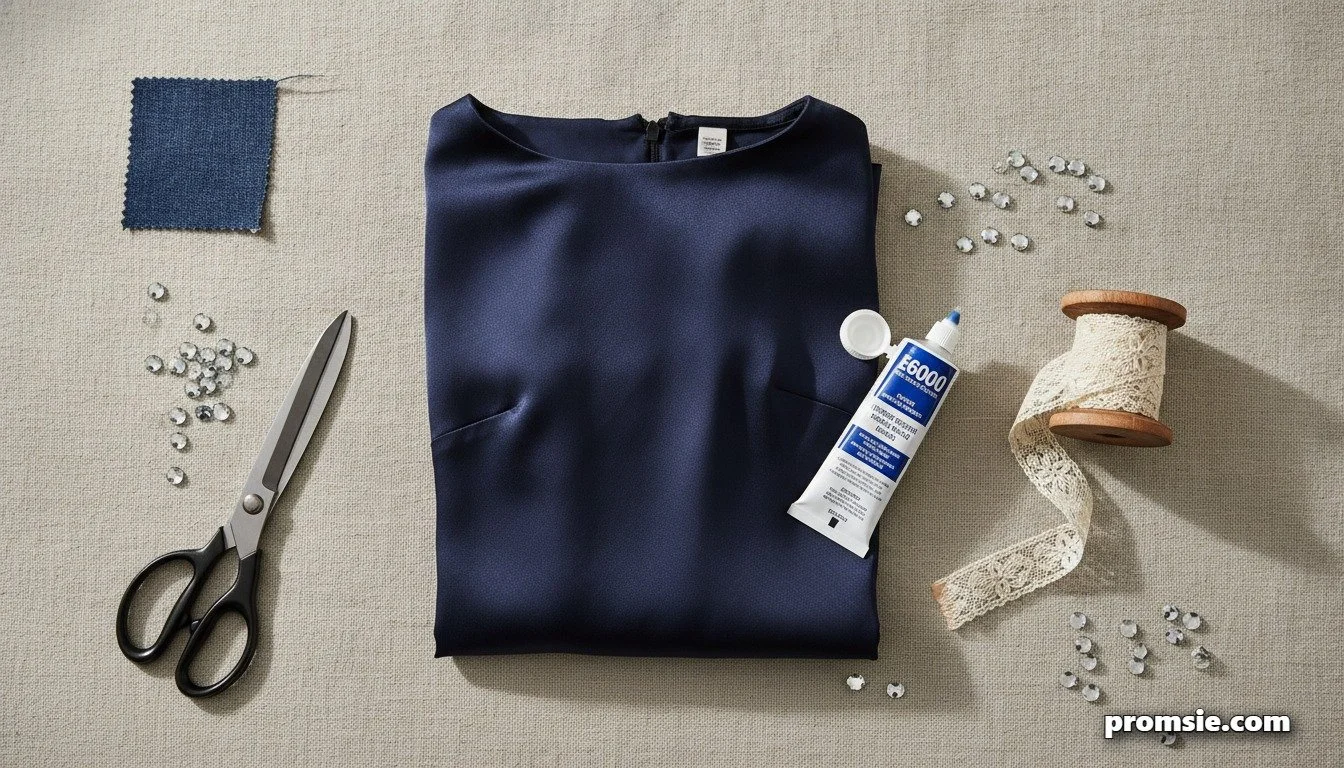
Before You Shop: What to Look For at the Thrift Store
Don't just grab anything and hope for the best. Go in with a short checklist:
Fabrics worth buying:
Satin and charmeuse — photographs beautifully, easy to hand-sew embellishments onto, forgiving of minor alterations
Chiffon — floaty and formal-feeling, great for overlay projects
Denim — extremely customizable (paint, bleach, distress, patch)
Velvet — instantly looks expensive, very forgiving of imperfect cuts
Fabrics to avoid if you're new to DIY:
Anything heavily structured with boning or built-in shapewear (hard to alter without ruining the fit)
Polyester blends that fray badly when cut
Anything with significant staining in a visible spot
Quick checks before you buy:
Run your hand along every seam — loose stitching is fixable, torn fabric is not
Check the zipper by testing it fully (both directions)
Hold it up to the light to spot thin patches or pulls
9 Upcycled Homecoming Dress Ideas
1. Rhinestone Neckline on a Plain Satin Slip Dress
A simple satin slip dress is one of the easiest thrift store finds. To elevate it: use fabric glue (E6000 works best) to apply rhinestones or small crystals along the neckline and thin straps. You can do a scattered constellation pattern or a dense band — both read as intentional and dressy. Takes about two hours and costs under $8 in rhinestones.
What to thrift: Any satin or silky slip dress in your size, ideally a solid color.
2. Cropped Blazer + Thrifted Skirt Two-Piece
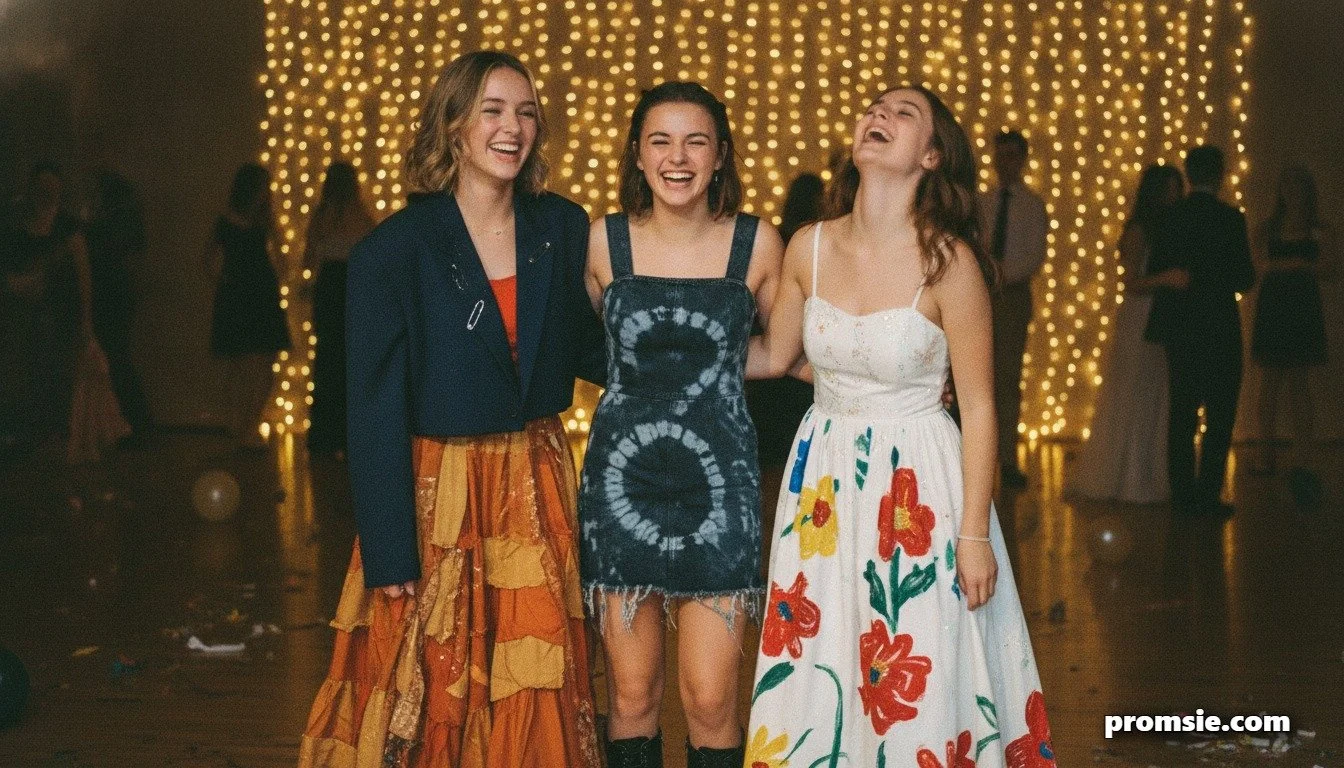
Men's oversized blazers are everywhere at thrift stores and almost always cheap. Cut just below the chest seam (use sharp fabric scissors and go slowly), leave the raw hem — it looks intentional on a blazer — and pair with a flowy midi skirt in a complementary color. You get a structured top half and a soft bottom, which is a legitimately good silhouette.
What to thrift: An oversized men's blazer in a neutral or interesting color, plus any A-line or flowy midi skirt.
3. Bleach-Dye Denim Dress
Take a plain denim dress — the darker the better — and create a gradient bleach effect by mixing 1 part bleach to 3 parts water in a spray bottle. Lay the dress flat outside (bleach fumes are real), spray from the bottom up with decreasing density as you move toward the waist. Leave 20 minutes, rinse thoroughly, and wash twice. The result looks intentionally designed, not accidental.
What to thrift: A dark-wash denim shirtdress or button-front denim dress.
Note: Wear gloves and do this outside. Test on a small hidden area first — some denim doesn't bleach evenly.
4. Lace Overlay on a Bandage or Bodycon Dress
Bodycon dresses are abundant at thrift stores but can feel a bit plain. Buy a yard or two of stretch lace from a fabric store ($4–$8/yard), cut it to match the dress length, and either hand-sew it at the top hem or use fabric adhesive tape. The lace sits over the original dress, adding texture and a more formal feel without changing the silhouette.
What to thrift: A fitted bandage-style or bodycon dress in a dark color (black, navy, burgundy work best under lace).
5. Maxi Dress Converted to Two-Piece
This one gets the most attention. Find a flowy maxi dress, cut it approximately 4–5 inches below the bust (this is your new crop top), and hem the cut edge with fabric tape or a simple hand-stitch. The remaining skirt portion is your maxi skirt — add an elastic waistband if needed. Two pieces, one thrift store find.
What to thrift: Any flowy maxi dress with a defined waist seam makes this easier. Avoid ones with complex prints that won't match up at the cut.
6. Fabric Paint Statement Dress
Take a plain white or light-colored cotton dress and use fabric paint to add a bold design. Floral motifs, abstract brushstrokes, or a single large graphic panel all work. Fabric paint is permanent once heat-set (run a hot iron over it with a cloth barrier). This is genuinely wearable art and there's zero chance anyone has the same dress.
What to thrift: A simple A-line or shift dress in white, cream, or light gray.
Tip: Sketch your design lightly in pencil first. Use a wide flat brush for background fills and a fine-tip brush or fabric marker for detail work.
7. Patchwork Denim Skirt
Find two or three pairs of thrifted jeans in different washes. Cut them into strips or panels, then sew or fabric-glue them together into a skirt shape. This sounds ambitious but patchwork is actually forgiving — the varied washes and edges are supposed to look imperfect. Pair with a plain fitted top and heels.
What to thrift: 2–3 pairs of jeans in different washes. Clearance bin jeans work fine since you're cutting them anyway.
8. Vintage Slip + Oversized Belt
Sometimes the transformation is in the styling, not the sewing. A 90s-style satin slip dress, belted tightly at the waist with a wide statement belt (also thrifted), reads completely different than the same dress worn unbelted. Add a blazer over the top for a layered look, or go minimalist with just the slip and belt. This works especially well for people who don't want to cut or alter anything.
What to thrift: A longer satin slip in any color. Statement belt — check the accessories section.
9. Embellished Collar Addition
Buy a plain dress you like, then thrift (or make) a detachable embellished collar — think lace, rhinestones, or beading — that sits over the neckline. A detachable collar changes the entire feel of a dress without permanently altering it. You can also thrift a vintage blouse just for its collar, carefully cut it free, and tack it onto your dress.
What to thrift: Any dress with a simple neckline. Vintage blouses with interesting collars are easy to find and usually under $3.
Prices based on typical US thrift store and craft supply costs. Savings calculated against the high end of retail.
Frequently Asked Questions
Do I need to know how to sew? For most of these ideas, no. Options 1, 3, 6, and 8 require no sewing at all. Options 2 and 9 need only basic hand-stitching — nothing machine-dependent.
How far in advance should I start? Give yourself at least 2–3 weeks. One week to find the right thrift store pieces, one week to execute the DIY work without rushing, and a few days buffer for anything that needs a redo.
What if I can't find the right piece at the thrift store? Check Depop, ThredUp, and Poshmark for secondhand pieces — you'll have a much bigger selection. Search by color and size, then sort by price.
Will it actually look good in photos? Yes — if you choose the right fabrics. Satin, velvet, and lace all photograph beautifully. Avoid anything matte and shapeless, which tends to flatten in photos.
Can guys do upcycled HOCO looks too? Absolutely. An oversized thrifted suit jacket tailored with a simple hem, or a vintage graphic tee tucked into thrifted dress trousers, is a legitimate and sharp upcycled look for guys.
The Bottom Line
A upcycled homecoming outfit done well doesn't look like a "DIY project." It looks like a considered, intentional outfit that nobody else has — because nobody else does. The key is picking the right base garment, committing to one clear transformation, and not overdoing it. One strong detail beats five competing ones every time.
About the Author: Robin covers homecoming and prom fashion for Promsie.com, with a focus on practical, budget-conscious outfit advice for high school students.