The Updo: Humidity-Defying Braids for the 2026 Prom Mosh Pit
Updated 11-July-2026
Nobody plans their prom hair around a weather forecast. Maybe they should. If your prom lands anywhere south of the Mason-Dixon line, or really anywhere with a humid late spring, you're not just picking a hairstyle.
You're picking a structure that has to survive several hours of body heat, sweat, and however many friends decide the dance floor doubles as a mosh pit this year.
A soft, romantic updo that looked flawless in the mirror at 5pm can be halfway collapsed by 9. That's not bad luck. It's chemistry.
Quick Read: Key Takeaways
- Humidity attacks hydrogen bonds, not hairspray — that's why soft updos wilt in a hot, crowded room.
- Dutch braids beat French braids for durability since they sit off the scalp and hold tighter tension.
- Splitting hair into 4+ braids (the "prize-fighter" method) spreads weight and reduces pulling.
- Hair sewing beats bobby pins in a mosh pit — nothing loose to fall out.
- A properly sewn braid set can last 2–3 days, covering prom night through next-day brunch.
Why Your Hair Actually Falls Apart in Humidity
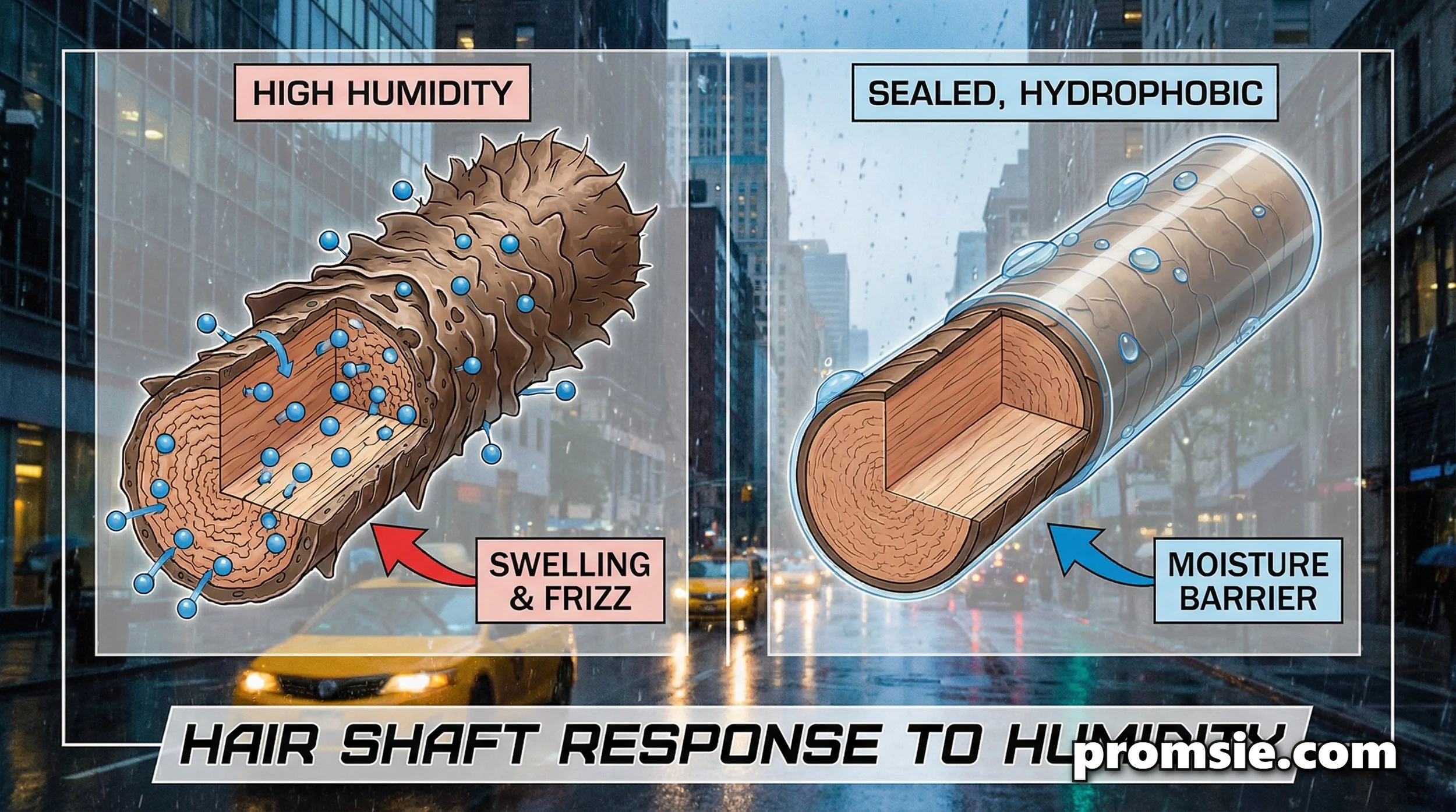
Hair holds its shape through a mix of chemical bonds. The permanent ones, disulfide bonds, are what a perm or a chemical straightener changes, and they don't care about the weather. The temporary ones, hydrogen bonds, are a different story entirely. They form and reform every time your hair gets wet and dries again, and they're extremely sensitive to water vapor in the air.
When humidity climbs, water molecules work their way into the hair shaft and disrupt those hydrogen bonds, causing individual strands to swell and the whole style to lose its shape since heating or wetting hair breaks the weak bonds holding the protein structure together, and water is especially good at forming those bonds.
That's the actual, scientific reason a blowout falls apart on a sticky night. It isn't your hairspray failing you. It's water physically getting inside the strand and pulling it back toward its natural shape.
This matters for prom specifically because you're not just fighting ambient humidity. You're fighting a room packed with a few hundred dancing teenagers, all generating body heat, all breathing, most of them sweating by 8pm. That's a localized humidity spike that has nothing to do with what the weather app says outside.
Why a Braid Beats a Soft Updo in That Environment
A loose, pinned updo relies almost entirely on hydrogen bonds and hairspray to hold its shape. Once those bonds start breaking down, there's nothing structural underneath to fall back on. It just droops. A braid is different. It's not really relying on chemistry to hold its form — it's relying on physical tension and interlocking strands.
That's a mechanical structure, not a chemical one, and mechanical structures don't really care what the dew point is. The Dutch braid specifically has an edge here.
Because the strands cross under the middle section instead of over it, the braid sits slightly raised off the scalp rather than lying flat against it. Two things follow from that.
First, it lifts hair away from the neck, which is exactly where sweat pools and heat gets trapped, so there's less of a personal steam room happening under your hairline.
Second, the underhand crossing pattern lets a stylist apply more even tension throughout, which means less unraveling if someone bumps into you mid-song.
For anyone who wants serious insurance, a fishtail crown takes this further. It uses two strands with small, frequent crossovers, which creates a lot of surface friction between the strands. Practically, that means if a hair gets snagged, it locks in place instead of sliding loose.
Most updos fail because they're relying on hairspray to fight water vapor, and hairspray just isn't built for that job," says Marisol Vega, a licensed stylist who specializes in braided and protective styles for formal events. "A braid holds through tension and friction instead. That's a mechanical structure, not a chemical one, so it doesn't degrade the same way when the room heats up.
The "Prize-Fighter" Approach: Splitting the Load
Athletes who move for a living, WNBA players, tennis players, don't show up in loose buns. They wear cornrows or box braids because the style has to survive actual physical exertion, not just a photo.
Prom hair can borrow the same logic. Instead of one large braid carrying the full weight of your hair, splitting it into four or more parallel Dutch braids distributes that weight across multiple smaller structures.
Less weight per braid means less pull on your scalp by the end of the night, and less chance any single section works itself loose. It's a small shift in approach, but it's the difference between hair that's still intact at last call and hair that needs a full redo by 10pm.
One caveat worth saying out loud: tighter isn't automatically better. There's a point where extra tension just becomes traction on the scalp, which isn't comfortable for a six-hour night.
Talk to your stylist about holding structure without holding pain. If you're trying to build a foundation for this kind of style well before prom night, our hair growth and prep guide walks through the months-out routine that gives a stylist more to work with.
Ditch the Pins, Try Sewing
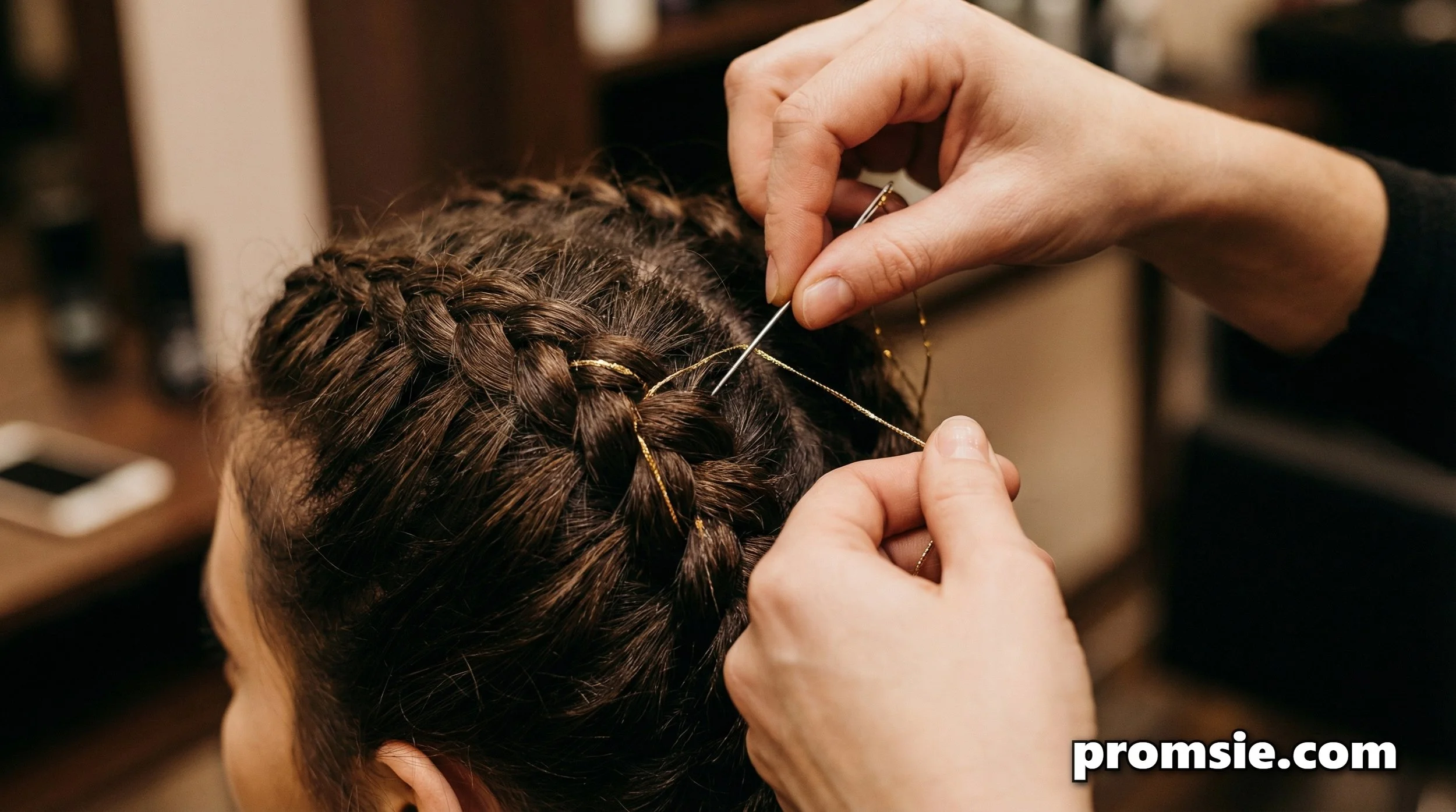
Bobby pins have a real failure mode in a crowded room: they're small, they're not anchored to anything, and a stray elbow can send one flying. For anything built to survive real movement, a lot of stylists have shifted to a technique called hair sewing.
Once the braids are placed, a stylist uses a blunt needle and thread that matches your hair color to literally stitch sections to each other. The result is one continuous, connected structure rather than a collection of separately pinned pieces. It holds up to far more than a normal hairstyle would, and there's nothing loose enough to fall out mid-dance.
It sounds intense for a school dance. It's really just borrowing a technique from theater and dance costuming, where hair has to survive far more physical movement than most updos are built for.
Finishing the Look Without Fighting Physics
The 2026 aesthetic leans toward sharper, more architectural finishes: think metallic platinum tones, slate brunette, and chrome accents rather than the softer palettes from a few years back.
Metallic pony cuffs snapped over elastics are an easy way to dress up the base of a braid without adding bulk. If you want sparkle, biodegradable glitter mixed into a strong-hold gel and worked along the part line hides sweat far better than loose glitter ever did, and it holds up under strobe lighting. For products, look specifically for something described as a humidity barrier or vapor-blocking spray, not just a standard hairspray.
Standard hairsprays hold hair in place; they don't do much to stop water vapor from getting into the strand in the first place, which is really the problem you're solving for. One thing people skip: freshly washed hair is usually too slippery to hold a tight braid well.
A texturizing spray applied beforehand adds grip, which actually makes the braid itself more secure, not just more voluminous. Want to round out the rest of the look?
Our prom accessories guide breaks down which hairpieces and metal finishes are working for 2026, and our prom night essentials checklist covers what to actually pack for touch-ups later in the night.
How Long Should This Actually Last
Done well, a sewn or heavily tensioned braid set can realistically hold for two to three days, which covers prom itself, the after-party, and brunch the next morning without a redo.
Sleeping on a silk or satin pillowcase overnight helps a lot here, since cotton pulls moisture and creates friction that frizzes the baby hairs around your hairline. That's really the whole idea behind this approach.
Instead of hoping a soft style survives an unpredictable night, you're building something that's engineered to handle it, so you can actually enjoy the dancing instead of checking a mirror every twenty minutes.
FAQ
Does hairspray actually stop humidity frizz? Not really, not on its own. Regular hairspray helps hold your style in place but doesn't create much of a barrier against water vapor getting into the hair shaft. Look for products specifically marketed as anti-humidity or vapor-blocking, and apply before styling, not just after.
How much does hair sewing cost compared to a normal updo? It varies by stylist and region, but expect to pay somewhat more than a standard pinned updo since it takes extra time. Most stylists who offer it will quote it as an add-on to a braided style rather than a separate service.
Will tight braids damage my hair? Properly done tension shouldn't cause lasting damage, but there's a real difference between secure and painfully tight. If your scalp is sore or you see red, irritated patches along the part lines right after styling, that's too tight, and it's worth asking your stylist to loosen the next set.
Can I do a mosh-pit-proof braid style myself at home? A basic Dutch braid is doable solo with practice, but the sewing technique and multi-braid "prize-fighter" looks really do need a second set of hands. If budget's a concern, look at cosmetology school clinics, which usually offer these services at a reduced rate with supervision.
How far in advance should I book this kind of style? Book two to three weeks out if you want a stylist experienced specifically in braiding and hair sewing, since not every salon offers it. That also gives you time for a trial run, which is worth doing if you've never worn a heavily structured braid style before.