HOCO - When is Homecoming and How does it Work?
Last updated 28-June-2026
If you've never been to homecoming before, the whole thing can feel a little overwhelming. Everyone around you seems to know exactly what's happening and where to be, and you're standing there wondering — wait, is the game before the dance?
Do I need a date?
What even IS spirit week?
Don't stress. This is the complete guide to how homecoming works — from the history behind it, to every single event during the week, to what actually happens at the dance. By the time you're done reading this, you'll know more about homecoming than most of the seniors at your school.
What Is Homecoming, Actually?
At its core, homecoming is a tradition where a school celebrates its identity and welcomes back alumni — former students who've "come home" to their old school for a weekend. That's literally where the name comes from. It's not just a dance. It's a whole week of events built around that idea of school pride and community, usually anchored by a football game and capped off with a dance on Saturday night.
The tradition is deeply American. You'll find versions of it at high schools and colleges across the country, but almost nowhere else in the world does it like the US does.
And while the "welcoming alumni back" part is technically the origin, let's be real — for most students today, homecoming is less about the alumni and entirely about Spirit Week, the game, the court, and that dance. The alumni thing is more background context than lived experience for most teenagers.
A Quick History (It Started at a Football Rivalry in 1911)
The first modern homecoming is generally credited to the University of Missouri in 1911, when athletics director Chester Brewer had the idea to invite alumni back to campus for a major rivalry football game against Kansas. It worked so well that other universities quickly copied it, and by the 1920s and '30s, the tradition had trickled down into high schools across the country.
By the mid-20th century — especially after World War II — homecoming at high schools had taken on a life of its own. The alumni angle stayed, but the focus shifted toward student experience: the court, the parade, spirit week, the dance. All of that evolved through the second half of the 20th century into what we know today.
Interestingly, the homecoming court (king and queen) is actually more of a high school thing. Colleges do have homecoming, but many don't crown a king and queen the way high schools do — that's a distinctly high school adaptation of the tradition.
| Region | Typical Window | Peak States | Key Features & Traditions |
|---|---|---|---|
| The Early Wave | Early to Mid-September | Texas, Florida, Georgia, Alabama, Arizona | Driven by early football season starts to beat the extreme late-autumn heat. Texas heavily anchors this wave, where dates dictate the massive "Homecoming Mum" preparation timeline. |
| The Peak Wave | Late September to Mid-October | California, Ohio, Pennsylvania, Illinois, Michigan, North Carolina | The absolute "sweet spot" for the majority of the US. Weather is ideal for outdoor parades and tailgates. Dates almost always center around high-profile local rivalry games. |
| The Late Wave | Late October to Early November | New York, New Jersey, Massachusetts, Washington | Common in northern states where the autumn climate shifts later, or in school districts with extended athletic calendars. Often overlaps directly with high school football playoff push. |
The only way to know your school's exact date is to check your school's website or student calendar — there's no national schedule. Most schools announce homecoming dates in August or early September, so keep an eye out.
The Full Week: Everything That Happens at Homecoming
Homecoming isn't just a dance. It's a week-long event with a whole sequence of things happening, usually building in intensity toward Saturday night. Here's how a typical homecoming week runs.
Spirit Week (Monday–Friday)
Spirit Week kicks everything off, and it's honestly one of the most fun parts of homecoming for a lot of people. Each day of the week has a different dress-up theme, and students — and often teachers — come to school dressed accordingly. The themes vary by school but some classics you'll see everywhere include:
Pajama Day
Twin Day (match outfits with a friend)
Decades Day (pick your era — '80s and '90s are always popular)
School Colors Day
Tourist Day or "Tacky Tourist"
Superhero Day
Jersey Day
Some schools go all-out with full competitions between grade levels — freshmen vs sophomores vs juniors vs seniors — for the most spirited class. Hallway decorating contests are common too, where each grade decorates their section of the school around the homecoming theme.
Spirit Week is honestly where a lot of the social energy of homecoming week lives. The game and dance get more hype, but Spirit Week is where you're connecting with classmates every single day.
The Pep Rally
Usually happening on Thursday or Friday (the day before or the day of the game), the pep rally is a whole-school assembly designed to get everyone fired up. Cheerleaders perform, the marching band plays, sports teams get introduced, and the general energy is absolutely chaotic in the best way.
Many schools use the pep rally to announce homecoming court nominees or even reveal the king and queen — though some schools save that reveal for halftime at the game.
Pep rallies can also feature "teacher vs. student" challenges, class competitions, or performances from the school's dance team. They're loud, they're silly, and they're a genuinely good time even if you're not usually into school spirit stuff.
Tailgating Before the Game
Before the football game, lots of schools have a tailgating culture where families, students, and alumni gather in the school parking lot. Think grills, folding chairs, food, and general pre-game vibes. It's relaxed, it's social, and it's a good way to ease into the energy of the game.
Not every school has a formal tailgate setup — some just have students hanging out before the gates open — but if yours does, it's worth showing up early for.
The Homecoming Game
The football game is the emotional center of homecoming week. It's not just any regular season game — schools typically schedule it against a rival or a team they have a strong historical matchup with, which raises the stakes considerably. The stadium fills up with current students, parents, alumni, and community members, all in school colors.
The marching band performs. The cheerleaders are at full intensity. The bleachers are packed. Even people who wouldn't normally watch a football game tend to show up for homecoming because the atmosphere is genuinely electric.
The game is usually played on a Friday night, which is traditional for high school football across most of the US.
The Halftime Show and Crown Ceremony
Halftime is one of the most anticipated moments of the whole week. The marching band performs (and if your school has a good band, this can be seriously impressive), and then the homecoming court is presented on the field.
Court members walk out, often escorted, while their names are announced. And then — the moment everyone's been waiting for — the homecoming king and queen are revealed and crowned, usually by the previous year's royalty or a school administrator.
It's one of those high school moments that sounds cheesy until you're standing there in the bleachers and suddenly it actually feels kind of magical.
Homecoming Court: How It Actually Works
The homecoming court is basically the school's elected royalty for homecoming week. It usually consists of a king and queen — both typically seniors — plus a prince and princess representing underclassmen (sometimes one per grade level). Some schools expand this further with dukes, duchesses, or "spirit ambassadors."
At single-sex schools, the court adjusts: all-girls schools might crown a queen and princess only, while all-male schools would have a king and prince.
How nominations and voting work
The process varies a lot by school, but the most common setup is a two-stage system. First, homerooms or student council run a nomination round to narrow the field down to a small group of candidates per grade. Then the whole school votes on who wins from that pool, usually during Spirit Week.
What's changed in recent years is the criteria. While homecoming court used to be essentially a popularity contest — which, let's be honest, it still partly is — many schools now require candidates to meet academic and behavioral standards before they're eligible to be nominated at all. A 2.5 GPA minimum and a clean disciplinary record are common requirements. It's still partly about who's well-known and well-liked, but there's more structure around it now.
If you're thinking about running, check out our guide on how to make homecoming court — there's more strategy to it than most people realize.
The crowning ceremony
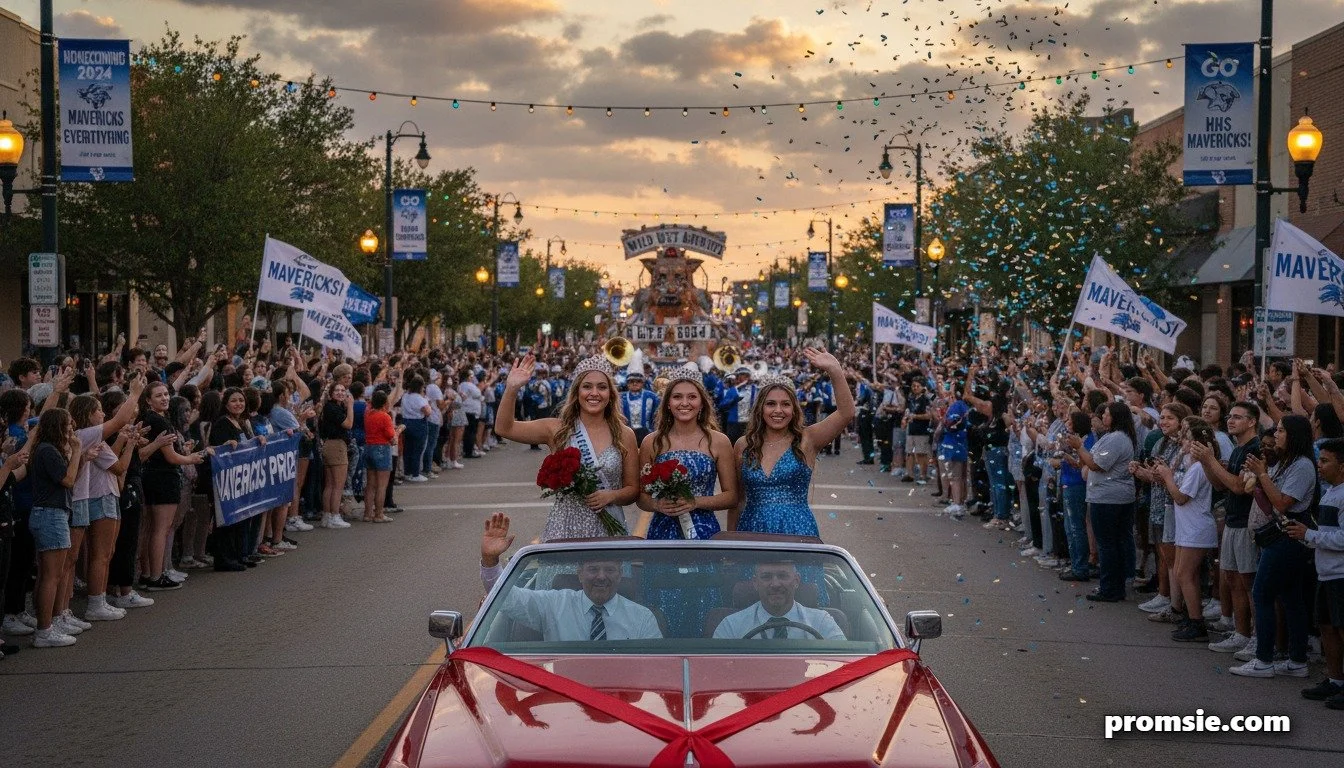
Winners are usually announced either at a pep rally or assembly before the game, or at halftime on the field. Court members typically parade in convertibles or on floats (especially in Texas, where this is basically a full production), and the queen and king are crowned in front of the crowd.
If you're crowned, you'll probably need to say a few words — keep it short, warm, and genuine. Thank the student body, give a shoutout to your friends and family, and enjoy the moment. You usually have about 20 seconds before the band starts up again.
In Texas specifically, the court tradition is on another level entirely. We've got a whole deep-dive on Texas homecoming mums if you want to understand how seriously they take this.
Robin's Take: What Homecoming Court Really Feels Like
Growing up in North Carolina, homecoming court was a huge deal. The nominations would start buzzing through school in late September, and everyone was talking about who was running, who had a shot, who was going to campaign hardest. Even if you weren't in the running yourself, it pulled you in. I remember the halftime ceremony at the game feeling completely electric — the kind of thing that sounds ordinary when you describe it but feels enormous when you're actually there. It's one of those experiences that just sticks with you.
The Homecoming Parade
Not every school has a parade, but many do — and when they do it right, it's genuinely one of the highlights of the week. Floats are built by classes, clubs, and school organizations, usually decorated around the homecoming theme. The marching band marches. The court rides through in convertibles. Community members and local businesses sometimes join in.
The parade usually runs through town or around the school campus, ending at the football stadium just before the game. Spectators line the streets, and yes, there's usually candy being thrown.
Float-building is its own whole tradition — students spend days constructing them, and there can be informal competition between grades for who built the best one. It's one of the more hands-on, creative parts of homecoming week.
The Homecoming Dance
Saturday night. This is the one.
The homecoming dance is the grand finale of the week, and for a lot of people, it's what they'll remember most. It's typically semi-formal — which means you dress up, but it's not the full black-tie formality of prom. Think cocktail dresses, cute minis, jumpsuits, or midi-length looks rather than floor-length gowns.
The venue varies hugely by school. Some schools hold it in the gym, others rent out a hotel ballroom or event space, and some do it outside on the school field. There's usually a DJ, sometimes a live act, and the dancing goes hard. The homecoming king and queen often share a first dance, and the atmosphere tends to be more casual and fun than prom — more dancing, less pressure.
Dance tickets are sold through school, and prices vary. Most dances run from around 7–10 PM, though after-party plans often extend the night well beyond that.
For dress ideas, check out our Homecoming Gallery — we've got loads of looks across different styles and body types.
Do you need a date?
Absolutely not. Going with a group of friends is just as common as going with a date — maybe more so. The vibe at homecoming is generally more relaxed than prom, so there's genuinely no pressure around the date situation. Our full guide to going solo to homecoming covers this in way more detail, but the short answer is: go, have fun, don't let the date question be the reason you stay home.
Can freshmen go?
At most high schools, yes — homecoming is open to all grades, freshman through senior. Some schools restrict the dance to upperclassmen only, and some have rules about bringing guests from other schools (usually requiring a form and ID). Middle school students generally can't attend. Check your specific school's policy, but the majority do allow all grade levels in.
Hoco Proposals: The Art of Asking
If you're going to homecoming with a date, there's a whole culture around how you ask. "Promposals" get more attention, but homecoming proposals — sometimes called "hoco-posals" — are very much a thing, especially in high schools where homecoming is a big deal.
They don't have to be elaborate. A creative poster, a small gift tied to an inside joke, asking after class with a bouquet — all of that works. What matters is that it feels personal rather than generic. The more specific it is to the person you're asking, the better it lands.
That said, there's zero obligation to do a formal proposal at all. A text asking if someone wants to go is perfectly fine. Read the room and the person.

It's not just about popularity anymore
Navigating the Homecoming Court selection is a two-tiered system. Most high schools run a preliminary nomination round through homerooms or student councils to narrow the field, followed by a school-wide vote during spirit week. While traditional criteria often centered purely on popularity, modern school districts frequently enforce strict prerequisites—such as a minimum 2.5 GPA and a clean disciplinary record—before a student can even appear on the ballot.
Homecoming vs. Prom: What's the Difference?
People ask this all the time, so here's the quick version:
The simplest way to think about it: homecoming is the fun, energetic opener to dance season. Prom is the emotional, grand finale. We've got a much more detailed breakdown in our homecoming vs. prom guide if you want the full picture on dress codes, costs, and vibes.
What to Wear to Homecoming
Since homecoming is semi-formal, you've got a lot more flexibility than prom. The general guideline is cocktail length — somewhere between the knee and mid-thigh — though midis and longer styles totally work too if that's your preference. Bold colors, fun prints, sequins, florals — all fair game. The energy is more "stylish and fun" than "elegant and sophisticated."
You don't need an updo. You don't need heels if you don't want them. The dress code is genuinely more relaxed.
For guys: dress pants and a button-down with a blazer is the standard. A tie is optional. A full tuxedo is overkill for homecoming — save that for prom.
Check your school's dress code before you shop, because most schools have guidelines around length and coverage that you'll want to be aware of early.
Frequently Asked Questions
Is homecoming just a dance?
No — it's a week-long celebration that includes Spirit Week dress-up days, a pep rally, sometimes a parade, the homecoming football game, the halftime court ceremony, and the dance on Saturday. The dance is the finale, not the whole event.
Do you have to go to the game to go to the dance?
No, they're separate events. You can attend the dance without attending the game, and vice versa. Tickets for each are usually sold independently through school.
What grade do you have to be in for homecoming?
Most high schools allow all four grades — freshman through senior — to attend homecoming. Some schools limit it to upperclassmen only. Check your school's specific policy.
Can you bring a guest from another school?
Usually yes, but there's almost always a process. Most schools require you to fill out a guest form in advance and have it approved. Your guest will typically need to show ID at the door. Middle school students are generally not allowed.
Is homecoming only in the US?
Essentially yes. Homecoming is a uniquely American tradition. Some Canadian schools have adopted versions of it, but it's not common outside North America.
What's the difference between homecoming and Spirit Week?
Spirit Week is part of homecoming — it's the dress-up days and activities that happen Monday through Friday in the lead-up to the game and dance. Homecoming refers to the full week and weekend of events.
Do you need a date to homecoming?
Not at all. Going with a group of friends is extremely common and honestly, often more fun. There's no expectation that you need a date, especially at the freshman and sophomore level.
How long does the homecoming dance last?
Most homecoming dances run from around 7 PM to 10 PM or 11 PM. Check your school's specific schedule — it varies.
Is homecoming formal or semi-formal?
Semi-formal. Think cocktail dresses and nice blazers, not floor-length gowns and tuxedos. That level of formality is reserved for prom.